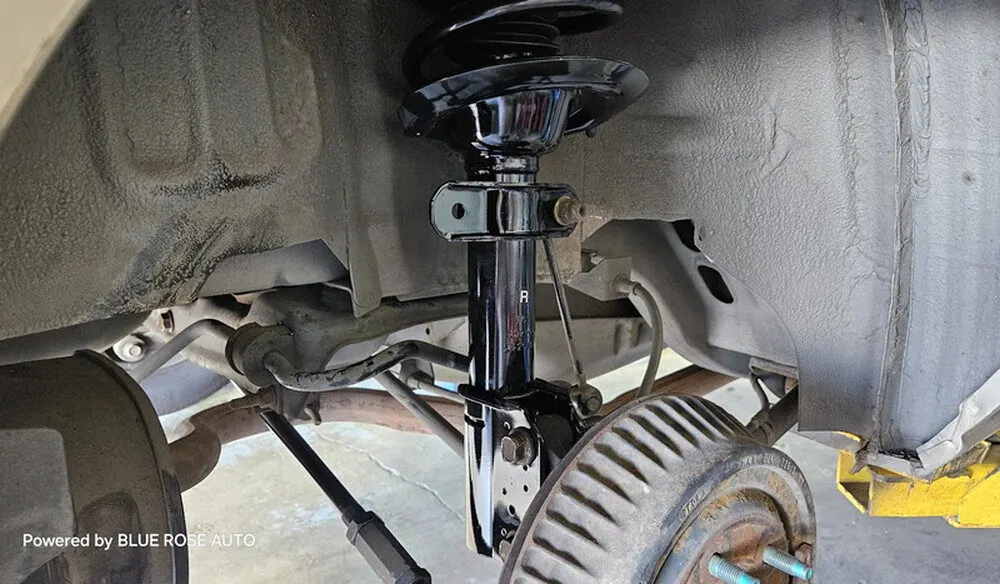
The clearest signs of bad shocks and struts are a car that keeps moving after a bump, a front end that dips hard when you stop, a rear that squats when you pull away, extra lean in corners, oil on the damper body, and tires with a scalloped, cupped tread. Any one of those is reason for an inspection. Two or more together usually means the dampers are finished.
The tricky part is that wear happens over tens of thousands of miles. You adapt to it. Most people only realize how tired their old struts were after driving the car on new ones.
Shock, strut or both?
Both parts do the same core job: they turn spring motion into heat so the car settles after a bump instead of bouncing. The difference is structural.
- A shock absorber only damps. Take it off and the car still sits at the same height on its springs.
- A strut damps and also forms part of the suspension. It carries the spring, holds the top of the steering knuckle and sets some of the wheel's angles.
Many cars use struts at the front and shocks at the rear. Pickups and body-on-frame SUVs often have shocks at all four corners. Your owner's manual or a parts lookup by VIN will tell you which you have.
Symptoms, from the driver's seat
| What you feel or see | What the damper is failing to do |
|---|---|
| Car floats and keeps rising and falling after a dip | control rebound after the spring compresses |
| Front end plunges under firm braking | slow the weight shift toward the front |
| Rear sinks and the nose lifts on acceleration | slow the weight shift toward the back |
| Body leans and wallows through freeway ramps | resist roll in a steady turn |
| Car feels nervous in crosswinds or when loaded | keep the tires settled on the road |
| Thumping over bumps, or a knock from the top of the strut | worn mount or internal failure |
| Tread worn in dips around the tire | let the tire hop and skip as it rolls |
That last row matters for your wallet. Cupped tires are loud, and the wear can't be undone, so a set of tires can be ruined by dampers that felt "fine."
Checks you can do in the driveway
Look for oil. Shine a flashlight on each damper body. A light film of dust is normal. A wet, oily coating that collects grime means the seal has failed and the damping fluid is leaving.
Look at the rod and boot. On struts, a torn dust boot lets grit reach the polished rod and wear the seal faster.
Run a hand over the tires. Cupping feels like a series of shallow dips around the tread, often clearest on the rear tires of front-drive cars.
Try a loaded drive. Put four adults in the car, or a typical load in the truck bed, and drive a road you know. Worn rear shocks show up as wallowing and bottoming out.
The old trick of pushing down on a fender and counting the bounces is close to useless on modern cars. Gas-charged dampers can pass it while being well past their best.
How long they last
There is no fixed mileage. Driving style, load and road quality all change it. Monroe points out that a typical damper strokes about 1,750 times per mile, or roughly 21 million cycles every 12,000 miles, and that worn units often show no outside sign at all, which is why the company recommends an annual inspection. Drivers who tow, haul heavy loads or spend time on broken pavement and gravel should expect a shorter life.
A sensible habit: ask for a damper check at every tire or brake visit once the car is past its first set of tires, and sooner if anything in the table above sounds familiar.
Why they are replaced in pairs
Dampers on the same axle should match. Monroe's guidance on replacing shocks and struts in pairs is that a single new unit next to a worn one creates uneven damping from side to side, which can make the new part work harder and wear other suspension parts sooner. The worn partner is usually not far behind anyway, since both have covered the same miles.
Front and rear pairs do not have to be done at the same visit unless both are worn.
What a strut job involves
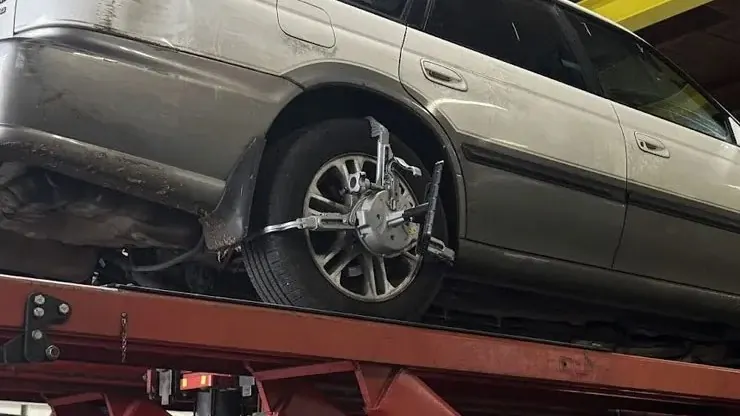
Front struts are often sold as complete assemblies, with the spring, mount and boot already fitted. That saves labor and replaces the rubber parts that wear alongside the damper. Because a strut locates the wheel, replacing one changes the alignment angles slightly, so plan on an alignment afterward. The wheel alignment guide explains what gets adjusted and why.
If the wear started after a hard strike rather than creeping in, read the pothole damage guide as well, since a bent part can mimic a worn one.
Getting dampers inspected in Springfield
At Blue Rose Auto, ASE-certified technicians handle mechanical repair from the Olympic Street shop in Springfield. Blue Rose Auto Care & Repair Services has been in business since 1994, when it opened in Junction City as Blue Rose Detail. For a longer list of warning signs written with Oregon roads in mind, the shock absorber article on blueroseauto.com is worth reading before you book. The rest of this suspension and steering series starts on the home page.