You need a wheel alignment when the car drifts on a flat road, the steering wheel sits off center while you drive straight, a tire wears faster on one edge, or right after new tires, steering or suspension parts, or a hard hit on a curb or pothole. Without any of those, a yearly check is a reasonable habit. Alignment does not fix vibration; that is usually balance, covered in the steering wheel shaking guide.
What an alignment actually adjusts
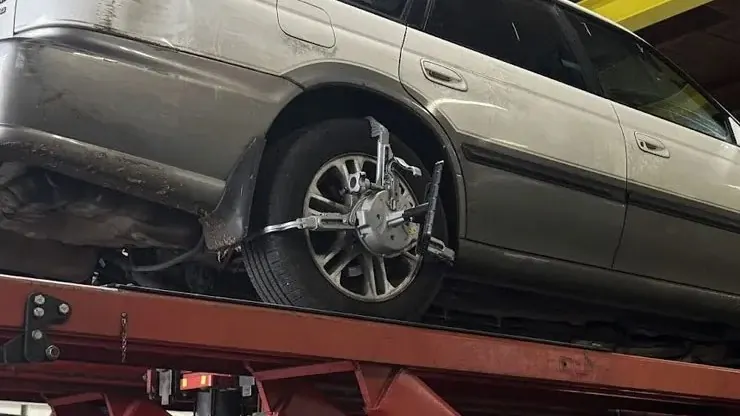
Every wheel sits at a set of angles to the car and the road. Carmakers publish a target and a tolerance for each one, often to a tenth of a degree. The technician measures the real angles with targets clamped to each wheel, then turns adjusters on the tie rods and suspension arms to bring them back into range.
| Angle | Seen from | What it is | What goes wrong when it is off |
|---|---|---|---|
| Toe | above | whether the fronts of a pair of tires point slightly in or out | tires scrub sideways; the fastest way to wear out tread |
| Camber | the front | how far the top of the tire leans in or out | one shoulder of the tread wears faster than the other |
| Caster | the side | the forward or backward tilt of the steering pivot | the car may pull, feel light at speed, or not return to center |
| Thrust angle | above | the direction the rear axle is pointing | car "dog tracks," steering wheel crooked even with the front set right |
Continental's tire engineers describe toe as the most common alignment problem and one of the hardest on tread life, and note that caster has little direct effect on wear. That matches what you see on the shop floor: toe errors eat tires; caster errors mostly change how the car steers.
Moments that call for a check
- 1New tires. Spending on rubber and then letting a toe error chew it up is the classic false economy.
- 2After steering or suspension work. Tie rods, control arms and struts all locate the wheel. Replacing any of them moves the angles.
- 3After a real impact. A curb strike, a deep pothole or a minor collision. The pothole damage guide has a short check routine.
- 4When the steering wheel is crooked. If the logo leans left or right on a straight, level road, something has moved.
- 5When the car will not hold a lane. Test on a flat, quiet road. Many roads are crowned for drainage, so a slight drift toward the shoulder can be normal.
- 6Once a year otherwise, or sooner on a car that sees gravel or rough roads.
Two-wheel, thrust or four-wheel?
The difference is how much of the car gets measured and adjusted.
- Front-end (two-wheel) alignment sets the front wheels only. It suits older trucks and cars with a solid rear axle that has no adjustment.
- Thrust-angle alignment measures the rear axle's direction and sets the front wheels to match it, even when the rear itself cannot be adjusted.
- Four-wheel alignment adjusts the rear as well as the front. It is needed on cars with independent rear suspension, most all-wheel-drive vehicles, and front-drive cars whose rear axle has adjusters.
Most cars built in the last few decades fall into the four-wheel group. If you are unsure, the alignment machine's vehicle database will show which angles have adjusters.
How to read the printout
Ask for the before-and-after sheet. It is your proof of what was done.
- Columns: "before," "after," and the specification range. Good shops print both measurements.
- Colors: green means in range, red means out. A red "after" reading should come with an explanation, usually a seized adjuster or a bent part.
- Look at toe first. It is the angle that most affects tire life, and it is always adjustable.
- Compare left to right. Camber and caster should be close side to side. A big gap with both inside spec can still cause a pull.
- Note anything "not adjustable." On many cars, camber or caster can only be changed with aftermarket kits. If one is far out, a bent part may be the reason.
Worn parts come first
An alignment is only as good as the joints it is set on. Loose tie rod ends or ball joints let the angles wander as soon as the car hits a bump, so a technician will usually check for play before aligning. Tired struts can affect ride height and camber on some cars, which is covered in the shocks and struts guide.
Alignment questions around Springfield
Blue Rose Auto Care & Repair Services, a Springfield, Oregon auto repair shop with ASE-certified technicians, keeps a blog article on a point that confuses plenty of drivers. If you have been quoted a "front-end alignment" and want to know whether your car needs more than that, Blue Rose Auto compares wheel alignment with front-end alignment in plain terms. Blue Rose Auto has been around since 1994. The other front-end guides are listed on the suspension and steering home page.